Presentation for the upcoming conference of the European Society for the Philosophy of Religion, KU Leuven, 10-11-12 September 2026, on The Revival of Metaphysics in the Philosophy of Religion.
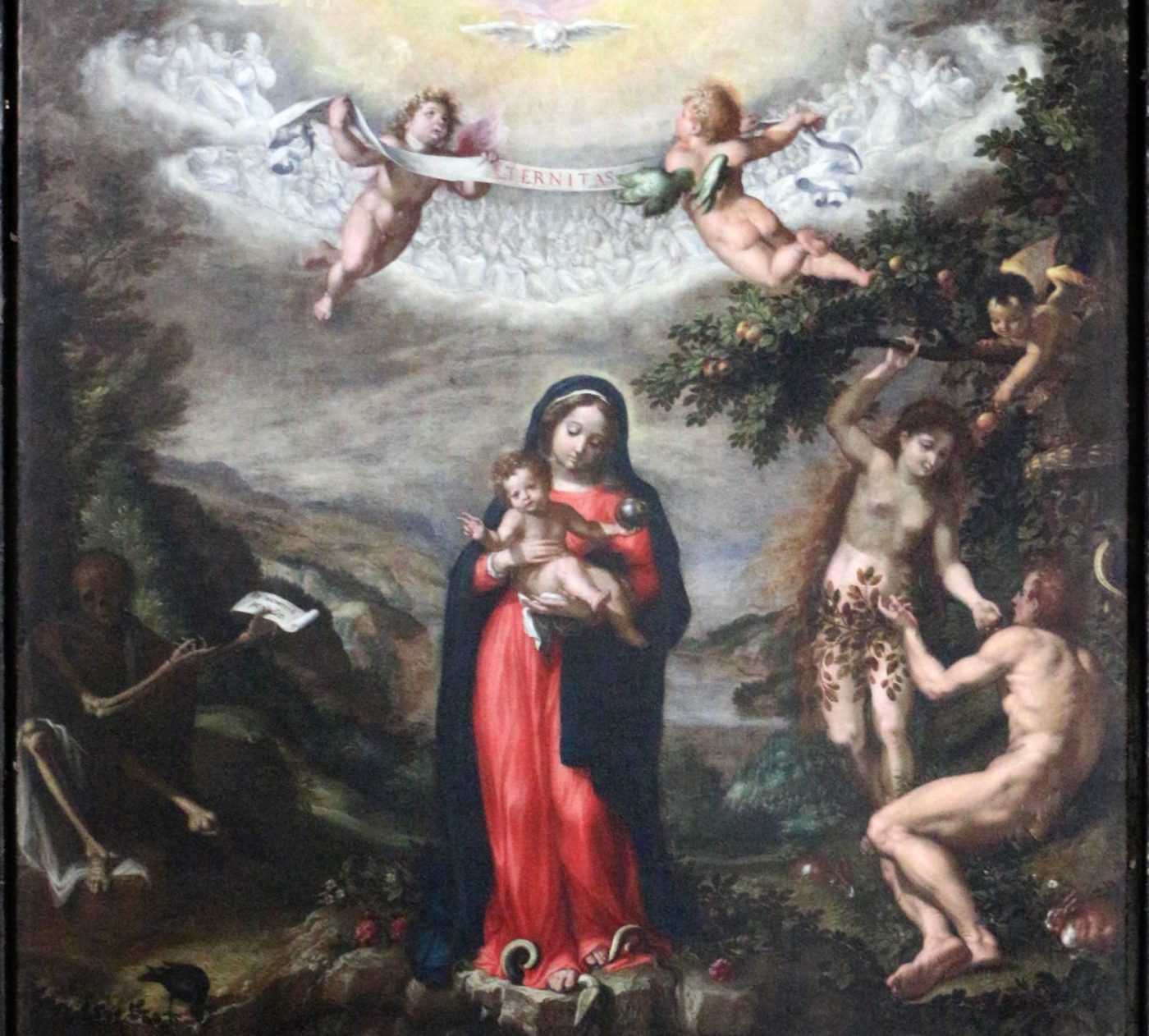
Painting: Immaculate Conception by Maerten de Vos in San Francesco a Ripa
Abstract
Although Heidegger rejected a theological interpretation of the most fundamental metaphysical question, this paper argues that its metaphysical and theological formulations can mutually illuminate and deepen one another. More specifically, the question “Why did God create the world, rather than not?” calls for a contrastive reason for creation that cannot be supplied by any necessary property of the creator, such as divine diffusiveness.
Heidegger’s contemporary Maximilian Kolbe offered a striking answer to this question in what appears to be an almost incidental remark: God created the world for Mary. This paper bridges the distance between Heidegger’s question and Kolbe’s answer through a common influence on both thinkers: John Duns Scotus, especially in light of his radicalization of contingency and particularity vis-à-vis Aristotle and Aquinas. The radical contingency of created being – grounded in the potentia Dei absoluta and destabilizing any necessary metaphysical structure between creation and Creator – finds its counterpart in the orientation of the creative act toward a particular contingent being as the contrastive reason for creation.
For Scotus himself, this would be the human nature of Christ, risking what Blumenberg called the “grotesque circularity” in Scotus’s thought. Kolbe’s answer moves beyond Scotus’s primacy of Christ to the primacy of the Immaculata as creation’s raison d’être. Moreover, in combination with Mary’s contingent fiat as resulting in the hypostatic union, this obtains a double decentering that escapes both a strictly theocentric and a strictly anthropocentric metaphysics, thereby restructuring being itself.For, as imago Dei creatoris, human beings reflect the same genuine power for opposites as the divine creative act. Accordingly, the fundamental metaphysical question arises for – and at the site of – every human being. Mary’s fiat is then the ultimate creaturely mirror of the divine creative ‘fiats’ in Genesis 1, resulting in the hypostatic union as the new creation and inaugurating a fractal structure of co-creative creaturely freedom that propagates contingently through time and history.


